• Skip to main content

AR Mavericks

Augmenting the reality of your life…

  • Home
  • Products
    • Tagisphere Portal
    • Tagisphere Projects
    • Tagis Tools =>
      • Tagis Mobile
      • Tagis CAD
      • Tagis Mapper
      • Tagis Surveyor
      • Tagis Web Map
  • Resources
  • Company
    • Contact
    • Legal Info
  • Login / Signup

Bill Wallace

Great Hope for a Good Metaverse: My report from AWE 2021

November 16, 2021 by Bill Wallace

Some images provided by AWE via FB

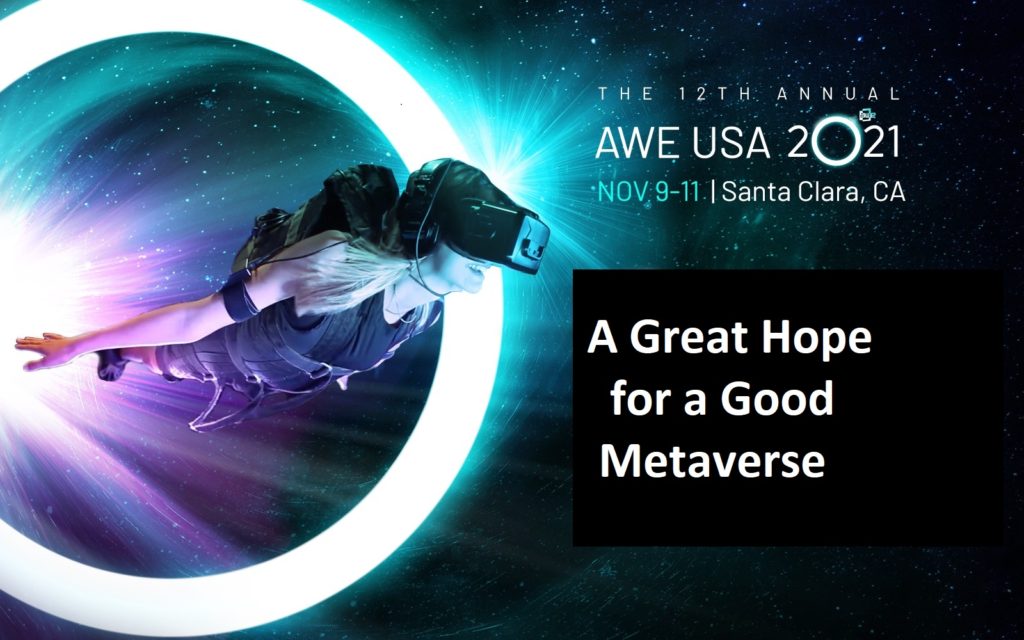
AWE 2021

I attended, In-person, the just completed Augmented World Expo, AWE 2021 in Santa Clara California; the preeminent XR/VR/AR event and feel I have some good insights to share. This report is truly Me-centric, providing my perspective and not at all trying to be a comprehensive review but will hopefully be of interest to some.

I mention many of the announcements and sessions that I found most important. However, I don’t provide much detail. Any one of the significant announcements from the show would require an article of their own, so this just gives a clue of what you may want to investigate further.

A “Good “Metaverse”

I’ll start out (just below) by sharing how this event affected me personally. The isolation of the long pandemic lockdown. The social division and unrest that is so forward in the news. That feeling that the world has changed and maybe not for the good was surely a low grade worry I wasn’t even aware I was carrying, but it was there. I think reuniting with a new tribe at this event was just what I needed to bring some sunshine back into my outlook.

For this year’s event, AWE should stand for Awesome Women Everywhere.

For this year’s event, AWE should stand for Awesome Women Everywhere. Yes, I am a dude but no, I am not making some chauvinistic or sexist comment here. In-fact what I am trying to convey is a bigger, social, or ethical aspect that I hadn’t expected at all. This is the reason for my title saying we have a great hope for a “Good Metaverse” in our future.

Our real world today is so full of what some term “woke” ideals, which in reality all seem to focus on just being good humans or maybe just humane. Regardless, if it is a focus on diversity or inclusion or equality or caring for the planet or just some basic love and respect, it all hopes for a better future.

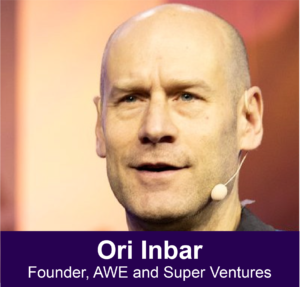
This is Ori, wearing a cARboard Max Headroom mask, not a Snap Lens

At this conference, starting with the zany, madcap (Max Headroom inspired) opening keynote by Ori Inbar (the father of AWE) and continuing throughout the event, there was an authentic “wokeness” (if you will) that was just inspiring. It feels like we really have woken up into a new day.

I am an old school (old) dude who has been around the tech industry for a very long time, notably in 3D. I attended conferences (back-in-the-day) at the Santa Clara Convention Center when it was brand new. Being somewhat engineering centric, these conferences used to be a big dude-fest. At AWE this year, Ori shared that more than ½ of the speakers were women. This was clearly not some plan to be inclusive but because they were the best persons to be speaking on their respective subjects.

Walking the halls and seeing all the various communities represented, it was just so inspiring. It gives me a hope for a “Good Metaverse”, but there is more. There were so many signs of our great new path.

Who Will Build the Metaverse, and Will it Lead to a Dystopian Future?
This two-point question was really a thread through the entire event. Ori addressed it in his opening keynote. Then, John Hanke (Niantic) dedicated the last ¼ of his keynote to directly addressing and rejecting the dystopian future. Another key theme, expressed nicely by Brielle Garcia in a panel discussion about the status of the Metaverse was (I paraphrase) “We are living in it now, it’s already happening.”

Looking around the conference I quickly realized, these ARE the people building the Metaverse. Of all the people on the planet, a good portion of those who will be noted in history as Metaverse pioneers (Pionerds) were at this event. The Metaverse isn’t being planned by some Meta organization. It won’t need someone to overlord and make sure it is “Good” or kidnap it for evil. We are already on a great path to a great future. We reject some dark fate for humankind and as we live our good lives each day, we are building the future we want to live in and that includes a good Metaverse.

OK, now two steps down off the soapbox.

What was the AWE Event?

The speaking sessions/tracks covered a huge variety of VR and AR subjects. The quality of the presentations was top notch in every session I was able to attend. The creator community was deeply represented. Such an incredible blend of tech and heart and talent. Surely populated by a younger tribe but such a wonderful and bright light shining on our future. Alongside the artistic creatives we had, for instance, a session delivering a deep-geek hardware presentation delving into the specs of a waveguide lens. You should be getting a feel for the breadth of topics. I even found some of my old tribe of construction site technologists showing videos of guys getting mud on their boots while traversing an early phase commercial building site wearing a HoloLens painting the scene in precise AR content.

The exhibit show floor was a lot bigger than I expected and I had several reasons to think it would be smaller. First, this a tightly focused market space in some respects. We are also still coming out of a state of pandemic uncertainty where 6 months ago when you had to start planning to attend, as an exhibitor, it was kind of impossible.

Not just the size of the show floor but the diversity of exhibitors helped me realize, this is sort of the “Maker” event for the Metaverse. Yeah, Niantic was the big 40 x 40 booth when you first walked in so end user consumer apps were represented. However, they were surely more focused on the newly announced Lightship as a tool provider for building the AR part of the Metaverse. Right across the aisle was a 10×10 both with a company who provides lens coatings for glasses manufactures. Kitty corner to them was a haptic glove maker. Just such a wide array of the base components of the Metaverse.

On my personal quest for valuable new tech, I found a software library provider, ReSight out of Tel Aviv, that has a world-scale spatial positioning solution that might solve some of my orgs critical path problems.

There was also a big playground area with dimmed lights and lots of corrals where you could play with various VR headsets, robot reality-capture dogs, volumetric capture rigs and the AR House chill area. I went over there several times to watch players swatting at the air and slaying dragons or armored horses with virtual broad swords or small axes.

Some Other Show Pieces

The show provided pretty good amenities. You could find a coffee service when needed. The evening happy hours had some finger foods and cash bar. The Auggie awards were well attended where the Next Generation Snap Spectacles won a well-deserved “Best Headworn Device” award. That is a big accomplishment considering all the great emerging solutions. IMHO Spectacles have a great form factor, great vivid display. Not perfect but surely one of the better releases of the year (should say limited release but will surely come public in some state soon).

There was an offsite Auggie awards after party at the Glass House in San Jose, but I didn’t make that so can’t comment.

My Favorites
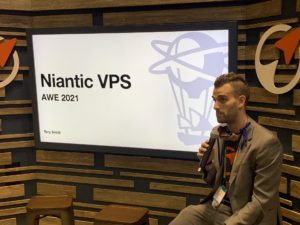
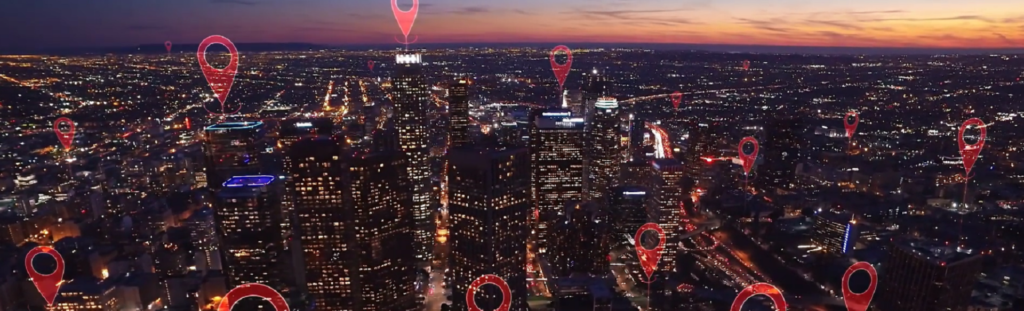
I mentioned Ori’s opening, great keynote which was followed by John Hanke’s (Niantic) keynote. It was a real tone setter for the event. The Lightship ARDK announcement was well received as well. I was most interested in the VPS (Visual Positioning System), think replace/augment GPS. It could be a great resource for me once it has mapped a good chunk of the world. It is kind of a future thing also, but soon they said. I tried drilling down with some of the tech management who were at the show. I have enterprise needs and ideas, but they seemed to be tightly focused (and reasonably so) on their community of users and a crowd-source scenario before considering any business and tech adaptation to the enterprise.

Cathy Hackel’s Shaping the Metaverse was a must-see session. Each panelist brought unique perspectives and insights on pretty much all the key topics like “What is the Metaverse?”, “When will it happen?”, “What about NFT’s or Crypto”, etc.

I posted about this before but will reiterate this here as it was a real lightbulb moment for me. In the discussion about NFTs, Dirk Lueth, founder Upland (I’m an Uplander and almost Pro) gave me some new insights. He spoke about NFTs, in the future, being our identity ownership. Like in our real world the car we drive and the shoes we wear are owned items that, admit it or not, are part of our identity. Therefore, in the Metaverse, using blockchain (NFTs) will allow us to replicate those identity embellishments and accessories with a similar ‘acquire and own’ concept. Of course, the flexibility in the Metaverse immediately causes brain-explode if you really think about it, but maybe later for that.


Session: The Future of Art and Creation: Interactive Art and Games in AR

  • Featured a panel of sort of Snap centric, super talented creators
  • Representing Bad Chick Studios, a guy who hangs at AR House (in L.A.), and Streem amongst others. All top notch.
  • Really cool insights. “Put a smiling face on things. It engages people. If an object just smiled at them and then my app crashes, they would boot it back up.” Brilliant!

Session: Usability in Wonderland: Advanced UX Standards for Spatial Computing and Virtual Worlds. Nicole Lazzaro

  • I’ve been following her for a while in places (not like stalking). This subject wouldn’t be top of mind for me, but I wanted to see what she had to share.
  • Beyond insightful. I hung on every word and concept. So many of the sessions showed a real dedication to the work, deep prep and passion translated into valuable guidance. This session exemplified that.
  • No more mouse pointer or windows, and a fresh and well though out way to facilitate deep engagement.

Session: Stereoscopic AR in WebXR

  • Some folks from MetaVRse and I “Think” backed up by Denali Advanced Integration (I hope I got this right) showed LIVE, 4 people with VR headsets all in a multiuser shared space all driven by WebXR. The excitement in the room really did make it feel like a historic event. “I was there when…” The new Kitty Hawk. They only flew for a few seconds, but we will be talking about it forever. Ha. At least it seemed like that to me.

I could never do justice to the sessions I attended that covered way more than I can discuss here. Financing, hardware, security, privacy, etc. With 5 or 6 simultaneous sessions, starting every 30-45 minutes, over 3 full days with over 300 speakers, the information was mega for sure. The conference was a clear inflection point for me, personally and professionally.

I came away inspired and refreshed and somewhat in awe of where we are headed and the people helping us get there. I am dedicated to building my little piece of the future and have a renewed energy and clarity of focus after this time together. I seem to end every article with this sentiment, but lets get to work building this great future.

Filed Under: Uncategorized

My (Almost) Million-Dollar Month in Augmented Reality

November 15, 2021 by Bill Wallace

A story about a startup business strategy in action

I’ve launched a new AR focused startup. Regarding the headline, it is very misleading. I haven’t actually earned a single penny of sales revenue yet. However, I did have an (almost) million-dollar month of sorts. I have just started to execute my business strategy and tactics and they are playing out (generally) as I intended. Market conditions are developing as I predicted, faster even, and I’m getting excited. This story is about launching a startup.

Things are not happening exactly as I planned. They obviously never do. It’s just that the surprises are, well, surprising. Some things have taken longer, and some things are happening way faster than I could have imagined.

AR Obsession

As I’ve mentioned in a previous article, I became obsessed with AR many years ago. At the time, I was a software product owner in a major global corporation, it was my job to watch trends and propose and deliver cutting edge solutions. However, I just couldn’t get any traction with my AR vision, we just had too much other backlog to head off in a new direction. I then tried getting hired into companies with potential or intention to get into AR, but I just couldn’t land a gig.

My obsession was real, so I needed to find some way to feed it. I decided I just needed to start my own company but how the heck would I get started? How could I fund it? I decided to leverage my side hustle in real-estate to flow some capital into my coffers to get me started.

One Strategy Point

I am bootstrapping (self-funding) at first. I want to maximize my pre-money valuation before I look for investment funding. I will try to fund this on my own up until I have some early (paying) customers. When I do look for an initial capital influx, I want to be able to get enough to really build the business while keeping a decent share of the equity for me and my fellow founders.

All In

I quit my high-tech, high-pay job. Well, it took three tries, but I finally did and went all in on my real estate scheme. I planned to take 6-9 months to do a few small flips and fixup and sell off my rentals. Then I could tackle the big flip, a 120-year-old 3,000 sq ft Victorian I already owned. It was decaying and decrepit, but I only paid $215k for it and it could be worth $750k if done right.

Not everything goes to plan. My first flip took 9 months, while I was still working my last corporate job. The cash ROI on that project was zero. I got my money back but that was it. The rentals did sell at decent prices so I could still launch the mega project.

I lived in the attic of the decrepit Victorian for 18 months while I went downstairs everyday and rebuilt the entire building. Oh yeah, I simultaneously had an offshore team and a few free lancers around the globe building prototypes of my AR platform, so I’d be able to hit the road running once I cashed in on the Victorian. Staying focused on my obsession fueled my daily work.


When I was nearly finished with the massive flip, the market in my area was smoking hot, properties in my price range were selling in 3 days with multiple offers. Things were looking pretty good. My place came out amazing and my realtor pegged my sale price at $884k. That is $130k over my original expectation. Oh yeah. I was completely burned out, nearly busted and so happy to finally be ready to sell this baby.
I listed the home (in June 2021) one week after covid restrictions were lifted in California and the buyers disappeared. Properties just stopped selling. Fast forward 90 days and I had only seen 5 buyers come and look at the home. No sale.

During those lonely 90 days I really felt the letdown, having expected the property to sell in a few days for over asking. I kept telling myself that God didn’t teach me how to swim, just to let me drown but I sure felt like I was going under. I had some severe self-doubt about my craftsmanship and my price expectations. Everyone was telling me what beautiful job I had done but hardly any potential buyers were looking. I really was all-in and needed an out. I had done my homework; I had managed my risk and could hold the property for the next year if I had too. I learned some good lessons there and a little bit about patience too.

Finally, the right buyer showed up and 120 days after I listed, I closed an all-cash offer for $875k.

Another Strategy Point

I’ve written before about my belief that AR will deliver a huge wave of business and specifically when AR glasses sufficient for my intended workflows are moving towards mass market acceptance. My explicit strategy is to build a viable AR business now (in the Visual Search segment) using mobile devices (phones/tablets) as the client, with the full intention that once the market swell caused by viable glasses happens, I’ll be a very attractive investment for the smart money looking to be in AR.

Such a Spectacle

We are seeing so much activity in the “AR” glasses game. Yes, many of the “AR” glasses or “Smart Glasses” are just camera glasses or audio glasses or HUDs. However, having been fortunate enough to be accepted into the Snap Next Generation Spectacles (4) beta program, I can say the new Spectacles are truly AR glasses. I would have to re-read my NDA to know what else I can say so I’ll just leave it at that. There are some other great solutions as well.

Having had my Snap awareness raised, I learned that Snap had funded a Ghost Fellowship grant program and I applied. I was seeking $125k to build out an amazing solution on the Spectacles platform. I made the first cut, got an interview and it went great with a great engaging team. I was really looking to push the tech farther than it can go at this time, but they got it, asked all the right questions, hard questions, and seemed enthusiastic. I evaluated the situation and felt I might have slightly better than even odds getting accepted.

I was so stoked. This extra $125k was not in my original plan at all. However, I had predicted that as AR started gain traction, gaining some attention, the money would start to flow into this segment. I was thinking maybe late 2022 when Apple ships their AR glasses. Now, in just the last months we have seen many of the big players and lots of upstarts making announcements about glasses, shipping products. We are even seeing the traditional early placeholder products from big players just so they can have a presence in the market while they play catch up. Heck, Snap has created a $3.5M grant fund to accelerate their platform. That’s just straight up cash on the barrel. Money was coming into this market.

I didn’t get the grant.

That would have made my million-dollar month. $875k + $125k. I let it get me down for about a minute and then I started concentrating on building my resolve. I’ll have a lot of these lost opportunities. I’ll need to experience a lot of lost opportunities to accumulate a few wins along the way.

Focus, Bill

What does an engineer do when the machine he is designing fails? Of course, they analyze the failure. They go back and review the relevant design principles, prior art, the acquired knowledge base of their education and experience. Break the problem down into its numbers, into measurable, smaller components that can each be analyzed, optimized, swapped out.


My machine is a business. So, what things do I know about such a business? For me, there are several software business “Truths” I have garnered from my education and building businesses inside corporations, grinding out in various startups, my own little ventures and learning from my friends and colleagues, from my failures and successes.

  • One magic number seems to be the $40M year.
    • If you can generate $10M a quarter, you are legit.
    • You won’t see an IPO without seeing that number first
    • That is a lot of fricking business for a guy with a prototype and “no customers — at all
  • In the software business, I think the standard target is to generate $200-$250k per employee, per year.
    • Let’s see, Google says Autodesk does $3.79B.
    • 1,500 employees
    • That is $330k per. Nice work Andrew.

Okay, I have a few first principles I can work with, but my design, my business plan, is a bit hard to write as a $40M business when I haven’t made my first dollar yet. However, I was generally comfortable with that “million-dollar month” concept.

The Million-Dollar Month

Ok, I can start to back into some numbers, mathematically. $12M a year divided by $250k per employee pencils out to 48 employees. That is a number I can envision. I only ever managed less than half that many people directly but, in a matrixed org as a product owner, I orchestrated the actions of many times that many people, in many different roles, taking my product to market. I never had CEO as my title so with that little extra kick-ass, my-word-is-law authority, I think I can do that.

Now when we are saying $250k per employee, we are not talking about 48 engineers. That headcount includes the lowly office boy, HR, PR, purchasing, sales, etc. So, as I envision growing an org from zero, the plan needs to be accountable for that total structure.

Backing into some more numbers, if I am targeting enterprise customers, then $1M a month means some distribution like 100 customers paying $10,000 each per month or 1,000 customers paying $1,000 per month. That starts to indicate a rather large sales org. Math again, each individual customer is at $12k-$120k per year. I think a sales guy might be able to find and manage maybe 10 customers that size. Therefore, I’ll need 10 fully loaded sales guys to deliver that revenue. Honestly, it’s probably more like 20 sales guys. That won’t fly. I can’t have nearly 50% of my org as sales guys if I am also building products.

My enterprise market experience has always included, or even been exclusively an indirect sales channel. Resellers. The cliché’s here are endless. An indirect sales channel is the worst type of sales channel, except for every other type of channel. Motivating resellers is like pushing rope. It’s not an 80:20 rule with resellers, 1 out of 10 resellers will deliver most of your sales. Unfortunately, these are not just cliché’s, I find them to be among the “truths” I spoke of earlier.

Even so, I never met a reseller I didn’t love. Honestly, these are the guys on the street in every big and little city. How in the heck can I make a sale in Omaha when I am sitting in California? The price of the flight alone kills the idea. If I can have one direct sales employee, reseller manager, who can effectively engage 6 or 8 reseller organizations, I can conceivably have dozens of salespeople on the street for each direct sales employee/manager. That drastically lowers the number of direct sales staff I’ll need. Yes, there are all levels of competence and enthusiasm in the reseller channel. However, if you can deliver the value to deserve the attention of a reseller, you can get it.

Building the Plan

I have not written much here about a successful product building process. I’ve written before about my approach to product planning and development. For me, that is the easy part. I’ve been a product owner and understand that realm. Now I am expanding my vision to being a business builder.

Strategy point number one is to hold off getting a capital influx until I have some paying customers. There is a long way between today and that waypoint. Therefore, my plan needs to devise a ramp that gets me that far. I won’t have 48 people in my employ while I am in my bootstrap phase. Regardless, I can at least stay focused on what is the critical path between here and those first few paying customers. What product and organization can get me that far?

Strategy point number two is to build a viable AR Visual Search product and business using mobile apps as the client. Then capitalize on the market buzz of AR glasses as they take off. Honestly, even in the time it took to pen this piece I started losing focus on that. The business issues of hiring sales guys, making a monthly target, it all starts to blur the focus. I need to keep a sharp eye on product. A product that can deliver to my target customer.

Organizing my thoughts for this piece has helped me sharpen my “Next Steps” focus. It also reaffirms to me I’ve been generally doing the right things so far.

In Action

LinkedIn has been a fantastic platform from which I can network and start to build out legitimate valuable relationships and move my business forward in this early phase.

Distribution: I have been connecting with distribution partners from my previous positions and finding new ones. Really smart people who are engaged daily with my potential customer base. I have really enjoyed briefing them on my platform and the problems it solves. About half of the engagements are super valuable. Some people have different interests or already have a strong focus elsewhere; or they just don’t get it. Regardless, I have several individuals and orgs ready to learn more and potentially take my product to their base.

Partners: I’ve been connecting with potential technical business partners. Both former colleagues and newly discovered connections. I have lined up some potential innovative integrations and have a shared vison about potential future markets opened by AR and associated spatial/geospatial tech, with some great folks.

Technical Innovation: I’ve also been meeting and having very cool discussions about technical challenges and developments of my AR platform. I feel so fortunate to be able to find and sometimes hire such brilliant folks to solve difficult issues that ultimately will deliver a simple product for my users. I really love being on that leading/bleeding edge and seeing potential and existing technologies come together in a vertical integration to make hard problems seem to have a simple solution.

In Conclusion

I’ll be out here working towards that real million-dollar month. I’ll likely share more about the adventure as things develop. I look forward to meeting new people and building great new things together. I hope you have found some value in my inner thoughts exposed and I am always open to having a candid discussion about the AR business, the startup challenge and stuff like that.

Filed Under: Uncategorized

Let’s Get to Work!

September 30, 2020 by Bill Wallace

Let’s Get to Work!

BLOG POST ZERO 5-of-5: This blog post is the 5th of a series of 5 posts. These 5 posts were also cross posted to my Linkedin account as a single article

The hard work lies ahead of us. There are still some technology gaps. The current positioning technologies are OK but we need more consolidation of GPS with SLAM or plane recognition, etc. I would say we can charge ahead as enough good people need to solve this issue so it will improve dramatically over the near term. There are some OK alignment techniques/technologies coming online. Mapbox has some manual alignment stuff available in their SDK for Unity. ESRI also has some tools buried in their ArcGIS SDK. These, and the others out there pretty much require manual intervention which will not work on a mass adoption scale.

It seems like Apple, Google, etc. are mostly waiting for development of full blown 3D city models.  Apple is dabbling with projects like their indoor maps program. The chaps at Dent Reality, out of London, have leveraged it to start doing a discrete indoor AR map-app solution. Facebook also recently acquire Mapillary which is surely more than just about maps and has big-time AR indictions.

The guys at Augmented.City are doing some interesting and valuable work trying to first build spatially indexed cities using a crowdsourcing method, then providing geolocated AR tags. This approach does head down the path towards solving the problem. You can lock into a local coordinate system once they have created and indexed a local “AR cloud” of your location. However, to map a significant number of cites, let alone the entire face of the earth, seems a bit like trying to empty the sea with a teaspoon. I think some combination of Tango like machine vision, real-time spatial mapping linked with AI and known maps will be the best path but who knows?  I’ll just implement what solution emerges as the best available.

On the survey-grade front, Trimble has released the SiteVision solution. To me it looks a bit like a kludge, a handle with a phone and a GPS antenna strapped to it, (I’d like to see the original duct-taped prototype) but admittedly, also seems fit-for-purpose. It starts to solve the problem but isn’t simple, isn’t free, or at least doesn’t feel free.

I will reiterate, we need to deliver a simple method to deliver this essentially complex technology. We need to find business models that remove the barriers to adoption but leave some meat on the bones, some revenue for the makers. So much of what we need is here, ready to be configured into valuable solutions. Global cloud access is proliferating as various networks / technology-plays expand their coverage and bandwidth. We’ve been collecting the “location of Things” for our lifetimes. The IoT has started to spawn the creation of necessary indexes back into the data. The display mechanisms on our mobile devices, the glasses, heads up displays, etc. are all already workable.

It’s all there for the taking. Will we be able to paddle like hell, drop in and catch the wave? I don’t want to just leave it here, but my AR mashed potatoes are getting cold and I need to get back to them. I, for one, have waxed my board. I’m watching for the swell and waiting for the next set to roll in. If someone sees them breaking outside, please do give me a yell and I’ll try to paddle out to catch that outside break if that’s where it’s happening. I hope to see some of you out there with me; it is going to be one hell of a ride.

A Final Thought

Rod Serling opened the television show The Twilight Zone with this monologue “There is a fifth dimension beyond that which is known to man. It is a dimension as vast as space and as timeless as infinity. It is the middle ground between light and shadow, between science and superstition, and it lies between the pit of man’s fears and the summit of his knowledge. This is the dimension of imagination. It is an area which we call the Twilight Zone.”

Rod was describing the Twilight Zone, but this is exactly how I see the future of AR; a vast and awesome dimension of access to the knowledge of the ages, just beyond our natural senses.

I thank you for reading. I thank Wikipedia for always having appropriate and useful links to act as my digital footnotes. Follow me on twitter, comment here or contact me if you’d like to talk about any of this or maybe better yet, just get to work delivering on this promise.

Filed Under: Journal

Innovation Drives Markets

September 30, 2020 by Bill Wallace

Innovation Drives Markets

BLOG POST ZERO 4-of-5: This blog post is the 4th of a series of 5 posts. These 5 posts were also cross posted to my Linkedin account as a single article

The AR wave will be more than just cool new shit to play with. This wave is a business opportunity of immense proportions.  I have always been amazed at how innovation drives economies in a free market. It’s really the beauty of the thing. Consider how some college student innovated his version of MySpace and created Facebook (Isn’t that what happened?). That one innovation essentially created an entire social media economy out of thin air almost literally overnight. Billions of dollars of wealth have been and are being  generated, and not just for the founders. How many social media specialists in every corporation, advertising company, and sizable business now have a swelling 401k in a career that didn’t exist a decade ago?

AR, done right, could drive the next big economic wave. However, good ideas don’t always equal good products. Big opportunities don’t always pan out to big gains. Some hard work lies ahead of us to make some good products and see this opportunity turn into gain for us all.

All that Glitters is Not Gold

You need more than a good idea for success; you need to build the right product to deliver the real value of an idea. Even though it looks to me like there are golden nuggets of AR opportunity just lying on the ground, I’ve also learned from my career in delivering technology that you must thread the needle to success. You need to find that specific combination of features, price model, audience focus, etc. to find true product breakthrough success.

I’ve enjoyed a career focused mostly on software technologies for industrial applications and construction (AEC) markets. I’ve been employed by leading global corporations and startups alike. I’ve worked in the areas of CAD/CAM/CAE, 3D Laser Scanning, Drones/Photogrammetry, 3D GPS Machine Control and survey/measurement/positioning technologies in general. I also came up through the Internet 1.0 era involved in early web portals and SaaS offerings back before AWS, Azure, etc. when you had to build your own heavy iron with physical boxes in a secure, rented server closet. In all that time, some of the most exciting innovations, to me, were not the technical achievements. They were more related to the “How” and not the “What” of the products. How they were priced, how they were marketed, how you reached your audience and led them to realize the value of your offering. This is, as opposed to what the exact and most innovative features were.

All those experiences have confirmed for a me a few basic product principles that, taken together, seem to quite often deliver success for the makers and the takers (users).

  • Configure existing and emerging technologies into a product vs spending your focus on trying to invent. Build on the shoulders of giants. Giants who have invested their money, not mine, to create the base innovation.
    • Faster time to market.
    • Potential competitors inventing better mouse traps are not competitors at all but your next mouse trap vendor for your tech stack.
  • Build the business, not the gadget.
    • There are lots of great inventions, but the best features don’t necessarily win, the best business does.
    • Identify your audience and how to reach them.
    • Let them buy the way they want
  • Make the complex simple. If you can wire together a complex stack of technologies into that proverbial big red “Do” button, you have a winner.
  • Make it “feel” free or make the purchase part of a natural progression of using the solution. This is the least resistance path to mass adoption.
    • Let a content provider pay for your tool to distribute her content to her audience, so it feels free to them. They will eat it up.
    • Of course, let advertisers buy access to your user’s eyeballs.
    • Then, let your users decide to pay to opt-out of the advertising once they have a habit of using your solution. This doesn’t feel like a buying decision, it’s just a convenience to improve/upgrade their ongoing experience, something they want.
    • Freemium or in-app purchases where a virtual coin slot lets users painlessly, mindlessly buy content, access, feature enhancement.

If we can configure the tech that exists and is emerging, adapt it for the audiences we know best and develop the correct delivery models AR will be a wave wide enough for all of us to catch a good ride.

Filed Under: Journal

The Glasses

August 31, 2020 by Bill Wallace

The Glasses

BLOG POST ZERO 3-of-5: This blog post is the 3rd of a series of 5 posts. These 5 posts were also cross posted to my Linkedin account as a single article

I’ve been riding the metaphor of a wave and I’ll extend that to propose the glasses as the metaphorical surfboard. Corny? Yes, but you’ve come this far–don’t abandon me now! AR on your phone or tablet is already more than viable. However, once we get the glasses right the surf will be up big time.

Like the first big lumbering (actually lumber) surfboards used by Duke Kahanamoku the first glasses such as the Google Glass fiasco (which weren’t really AR glasses anyway)  and others haven’t yet provided a very smooth or exhilarating ride or even really support a true AR experience.  Right now, there is not even a decent taxonomy to describe the variations of (quote unquote) AR glasses.

  • 2D
  • 3D
  • Heads Up Display (HUD)
  • V and H FOV
  • Degrees of freedom
  • Eye tracking
  • Head tracking
  • Plane detection
  • Hand tracking/gesture capabilities
  • AR, VR, MR XR
  • Location-based
  • World-scale
  • etc.

For my purposes, placing geolocated data in the visual scene, only a few current “AR” glasses provide the necessary capability. In any regard, its likely a few years before any of the glasses are mass market ready anyway.

The list of work going on in this area would fill the rest of the page. To name just a few, we’ve had Epson’s MOVERIO glasses for a while. Their premium version seems to support location and augmenting the 3D scene. Bosch’s  Light Drive  an OEM HW/SW toolkit solution for “AR” glasses is a great start down the toolkit path but is just a HUD method right now, not 3D location-based, or whatever we will call it. I do wish someone like Norm Glasses would add location, and Snap Spectacles seem to be close but I’m not sure they have actual location capabilities.

I’ve only started my organization down this path of research and for now the phone and tablet are still king. Also, if this posting is a few days old, who knows what else has come onto the market since I wrote this. So, for now the field looks mostly like HoloLens, MagicLeap and maybe nreal. HoloLens and Leap both have lots of good and bad aspects but at least they are out there trying to catch (or create) the wave. nreal remains a bit of a mystery but doesn’t quite look geo-aware yet, but maybe, just not sure. Maybe it does take mega-corp or a Rony Abovitz (Visionary and CEO of MagicLeap) with billions in funding to make this happen. Honestly, don’t look to me to instruct you on what solutions are available. The market has new entrants every day and once someone nails it, we will all be dropping in on some epic waves for a full ride. I’ll ride whatever board can give me the best ride for the current conditions.

Some may even question if AR enabled glasses will ever be a viable business after the early failures and slow adoption. The assumption that a massive wave of adoption will occur might even seem foolhardy. Of course, there are a lot of folks in my camp as well who all consider it a foregone conclusion that the wave is coming, and the glasses will be prolific. Consider a few of these thoughts.

According to the Vision Council of America, approximately 75% of adults use some sort of vision correction and about 64% of them wear eyeglasses (it’s on the Internet so it must be true). If an ergonomic and affordable value-add can be offered to the wearers of those glasses, it seems there is a huge audience already primed for adoption.

On many/most construction job sites, safety glasses are already mandated. Who would reject the additional value-add of an AR hyperlinked jobsite once the economics work and access to valuable data is easily and readily available?

Another argument to support adoption of glasses by the masses is to consider another form of reality augmentation that required a like-kind adoption curve. We’ve relegated “Augmented Reality” to the visual context. What about our “audio reality?” We’ve been augmenting our audio reality with devices since Edison. Remember the Walkman? Who thought the world would accept such a thing? And yet ear buds, beats and office headsets are all now just part of our daily attire.

Yeah, we surely need some killer apps but if that’s all that stands in the way, let’s innovate!

Filed Under: Journal Tagged With: Creatives

Connecting “Things”

August 31, 2020 by Bill Wallace

Connecting “Things”

BLOG POST ZERO 2-of-5: This blog post is the 2nd of a series of 5 posts. These 5 posts were also cross posted to my Linkedin account as a single article

As I said in a previous post, for me, the real opportunity for AR lies in the combination of mobile AR and world-scale geolocated things. Many “Things” live in one specific location on the earth. Many of those Things already have data somewhere in the cloud that could be useful to get now. AR solves the problem of connecting the Thing with its data. Extend that thought to all the things that could have useful data available and well, it boggles the mind. Me…I start making those virtual AR mashed potato mountains I mentioned in a previous post.

To look at a simple infrastructure use-case, the Thing in question could be a residential gas meter, an electric transformer on a power pole or a fire hydrant that will be sitting in the same (geo) location for a long, long time. I would venture to say we have the geolocations of those Things already documented in some GIS or spreadsheet, or some surveyor is out collecting that information right now. I would also venture it is not a bridge-too-far for that Thing data to be accessed via the cloud. So, the work at hand is to connect the Thing to its data, and to distribute or deliver an AR-enabled link to the geolocation of the Thing so an interested party can enter the data path of that Thing from where it lives. Link to the Thing, where it lives, and we can get into the associate data repository in a business system, control system, work order system, BIM, Bam, Bing (or Google), you name it.

Of course, not everything we care about is locked to a given location. In addition, with the IoT firestorm churning out Thing data at an incredible rate, both the “what” and the “where” are huge (literally) moving targets. Fortunately, we can always build on the shoulders of giants. For instance we have the important indexing work being done by the brains at Terbine where they have a super forward thinking solution to getting a handle on the data of the IoTs and it even has potential to track the “where” also. So, if we can establish a reliable method to identify the current physical location of a Thing or a method of recognizing that Thing itself, then AR can act as our on-ramp to the cloud to access its relevant information.

Of course, the question of “where” or “what” a Thing is, is simple to solve for many available technologies like GPS or machine vision joined with AI. We also have the question of data standards, standard access methods, display methods, etc. Like Terbine working is working on IoT standards, groups like Open AR Cloud are busy at work on a path to develop those standards for AR. If you are as geeked out about this industry as I am it is probably worth reading the Open AR Cloud (170 page) 2019 manifesto. While I disagree with some of their conclusions and approaches, they do have a similar vision to mine in the expansive nature of this coming wave.

Our work lays ahead to start connecting the dots. Connecting technologies into solutions. Creating necessary technologies to fil in the gaps. Obviously, one of the biggest dots I’ve assiduously avoided mentioning until now is the glasses; AR enabled glasses. Interestingly, when one thinks of AR glasses one of the first things to come to mind is Magic Leap. The visionary of that venture, Rory Abovitz, has also envisioned a similar future when speaking about what he calls the Magicverse. I just hope my vision doesn’t start to fade away as it seems may be happening at Magic Leap.

Cue the 5-tone tuba flourish, voice of the mothership, from Close Encounters.

Filed Under: Journal Tagged With: Creatives

Surf’s Up: The Augmented Reality Wave is Coming!

August 29, 2020 by Bill Wallace

Surf’s Up: The Augmented Reality Wave is Coming!

BLOG POST ZERO 1-of-5: This blog post is the first of a series of 5 posts. These 5 posts were also cross posted to my Linkedin account as a single article

It has been a persistent tick, tick, tick in the back-of-my-mind for years. Augment Reality is coming and it will change our world. Please understand, I am not talking about putting mustaches on apples, Pokemon Go or star-fighters placed hovering in the mall. All of those are valid (and kinda cool) implementations but I am talking about a wave of change as big as the Internet, as big as the cloud and in fact a confluence of those two behemoths, plus IoT and well, pretty much everything else. The AR wave is coming, and it will wash over everything we know.

To be clear, I am speaking about mobile AR coupled with world-scale Geo-located information. AR will deliver the visual index to everything we want to know. Our world will be hyperlinked right before our eyes. For the most part the tech is already here. We see new AR-focused tech announced every day. There is also a huge swell of associated technologies in IoT, 5G, AI, machine vision, reality capture, etc. which all play into an amazing future just ahead. There remains just the hard work and opportunity between today and the realization of that reality… that Augmented Reality. I believe that those of us in the technology delivery stream, especially those of us in the geospatial arena, should almost feel obligated to get on with the work required to deliver on the real promise of AR as a refence system to the word of information that surrounds us.

I am enthralled by the prospects of the massive effect this impending wave will have. As I opened with, it is a persistent thought I just can’t seem to shake. I liken my condition to that of Richard Dreyfuss in the movie Close Encounters, and I have a strong compulsion to start building mashed potato AR mountains on my kitchen table.

If you’ve had similar thoughts or are intrigued by the proposition, I hope you’ll find this quick read validating, informative and thought provoking. My perspective presented for your consideration.

The Wave

I have just founded a new AR focused startup, AR Mavericks, Inc. It’s been a fantastic experience so far. I‘ve really enjoyed finding team members and engaging in the creative process of refining the vision. I chose the Mavericks name for two reasons. A maverick is of course a rebel or someone who blazes their own path and I like that attitude. Apropos the pending AR wave, Mavericks is also a world-renowned surf break near Half Moon Bay in the San Francisco Bay Area, near where I live. When the surf is up at Mavericks they are riding 30 foot waves.

The metaphor should be obvious. This is one of those subjects where I could go on for several thousand words exploring the rich correlation between aspects of Mavericks’ break and the pending AR wave. However, for now I’ll just say if you are in the technology business and in any way involved with information (Information? Uhh… everything), you will want to be sure you are paddling to catch the AR wave. The storms out at sea are building up energy, the wind is right  and the swell is headed our way. Don’t get caught outside the break and miss the ride or worse yet, be sitting at the bottom, looking up at your pending doom.


Filed Under: Journal Tagged With: Creatives

  • Home
  • Products
  • Resources
  • Company
  • Login / Signup

Copyright © 2026 · AR Mavericks • Legal/Privacy • Contact